


Ethics approval
All experimental procedures in this study were reviewed and approved by the University of New England Animal Ethics Committee (Approval Number: AEC18-070) and conducted in accordance with national and international guidelines. In accordance with the AVMA 2020 euthanasia guidelines, the birds were first electrically stunned and sedated before being euthanized. Euthanasia was performed through decapitation using a sharp knife to ensure a humane and effective process. Furthermore, this study adheres to the ARRIVE guidelines to ensure the ethical treatment of animals and the transparent reporting of all experimental procedures.
Experimental design and bird allocation
A total of 990 male day-old Ross 308 chicks were sourced from a commercial hatchery (Darwalla Poultry Distributors Pty Ltd., Mount Cotton, Queensland, Australia) and delivered to the Centre for Animal Research and Training at the University of New England, Armidale, NSW 2351, Australia. Upon arrival, the chicks were weighed and randomly allocated to five dietary treatments using a completely randomized design. Each treatment was replicated 11 times, with 18 chicks housed per floor pen (average initial pen weight: 711 ± 3.0 g).
The main feed ingredients used in this study, wheat, corn, soybean meal, canola meal, and canola oil, were sourced from Nutrien Ag Solutions (6 Endeavour Drive, Armidale, NSW 2350, Australia). As outlined in Table 1, the basal wheat-corn soybean meal diets were formulated to meet the nutrient requirements of the birds, following the breeder recommendations1. The diets were offered in three phases: starter (0–10 days), grower (10–24 days), and finisher (24–35 days). The five dietary treatments were designed as follows: T1 (Inorganic diet – INO): 100 mg/kg Zn from ZnSO₄ and 15 mg/kg Cu from CuSO₄; T2 (Hydroxychloride diet): 100 mg/kg Zn from hydroxychloride Zn (HyZ) and 15 mg/kg Cu from hydroxychloride Cu (HyC); T3: 80 mg/kg Zn from HyZ and 100 mg/kg Cu from HyC; T4: 80 mg/kg Zn from HyZ and 150 mg/kg Cu from HyC; T5: 80 mg/kg Zn from HyZ and phase-specific Cu levels of 200 mg/kg for starter, 100 mg/kg for grower, and 60 mg/kg for finisher from HyC. A HyZ dose of 80 mg/kg was selected based on our previous studies, which demonstrated that Zn supplemented in hydroxychloride form at this level is sufficient to optimise growth performance and bone strength in broiler chickens21,22. All mineral premixes were prepared at the University of New England nutrition laboratory and analyzed for mineral content before incorporating them into the experimental diets. The Cu and Zn sources used were either feed-grade CuSO₄ and ZnSO₄ or hydroxychloride Cu and Zn (Selko IntelliBond Zn, Trouw Nutrition, Netherlands).
All diets were pelleted, with the starter diet further crumbled to enhance feed intake during the early growth phase. The initial shed temperature was maintained at 34 ± 1.0 °C for the first three days and was gradually reduced to 23 °C by day 21. The lighting program and ventilation were managed in accordance with the recommendations outlined in the Ross 308 breed management manual24. Birds had ad libitum access to both water and feed throughout the entire study period.
The body weight and feed intake of birds were recorded on a pen basis at day 0 and at the end of each feeding phase to calculate feed conversion ratio (FCR) and body weight gain. The body weight of any dead or culled birds was also recorded and used to adjust FCR calculations. On day 35, a body weight-corrected FCR was calculated and reported to account for treatment-associated differences in body weight. This correction was based on the assumption that a 50 g difference in body weight corresponds to a 1-point change in FCR. The rationale for this adjustment is to reflect commercial growing practices, where birds are typically reared to a target weight rather than a fixed age.
Sample collection
Triple representative composite samples were collected from all diets and premixes and analyzed in duplicate to determine mineral concentrations. On day 21 of the trial, three birds per pen, selected based on proximity to the mean body weight of the pen, were orally gavaged with fluorescein isothiocyanate-dextran (FITC-d) at a dosage of 4.16 mg FITC-d per kg live body weight (Sigma–Aldrich Co., Castle Hill, NSW, Australia). After 210 min, blood samples were collected from these birds into vacutainers containing lithium heparin for serum separation. Serum samples were harvested into individual Eppendorf tubes and frozen at −20 °C for subsequent FITC-d analysis. The three gavaged birds were euthanized in accordance with the AVMA 2020 euthanasia guidelines, where the birds were first electrically stunned and sedated before being euthanized. Euthanasia was performed through decapitation using a sharp knife to ensure a humane and effective process. Approximately 1 cm sections of the mid-duodenum from each bird were collected, washed with PBS, and fixed in 10% buffered formalin for histomorphology measurements. Following euthanasia, sub-samples of caecal digesta were collected, snap-frozen in liquid nitrogen, and stored at −80 °C for subsequent microbial population analysis using real-time quantitative PCR (qPCR).
On day 35 of the trial, three birds per replicate pen (33 birds per treatment) with body weights close to the pen average were selected and euthanized using the same method described previously. Liver samples were collected individually into 60 mL plastic containers and stored at −20 °C for subsequent mineral analysis.
Additionally, the right tibias were excised from these birds, and all soft tissues and cartilage were carefully removed. Breast fillets, thigh + drumstick, and abdominal fat pads were dissected, weighed, and expressed as a percentage of live body weight (g/100 g) to calculate yield percentages.
Fresh excreta samples were also collected from three birds and pooled per replicate pen. The excreta samples were mixed properly, oven-dried and then ground to pass through 0.5 mm sieve. Sub-samples of the ground excreta were used for mineral analysis.
On the same day, all birds in each pen underwent visual inspections for footpad dermatitis and hock burns. Both feet were examined, and any signs of footpad dermatitis were scored on a scale from 0 to 4, based on the criteria outlined by Stracke et al.25. Hock burns were similarly scored from 0 to 4, following the guidelines provided by Welfare Quality26.
Tibia breaking strength and mineral analysis
The tibias were subjected to a breaking strength test using an Instron instrument (LX 300 Instron Universal Testing Machine, Instron Corp., Canton, USA), equipped with a 30 kN load cell and a three-point fixture bed. The test was conducted at a speed capturing 10 data points per second, and the system was operated via Blue Hill 3 software.
Following the breaking strength measurement, the tibia samples were dried in a Qualtex Universal Series 2000 drying oven (Watson Victor Ltd., Perth, Australia) at 105 °C for 24 h to determine their dry matter content. The dried tibias were then ashed in a Carbolite CWF 1200 chamber furnace (Carbolite, Sheffield, UK) at 600 °C for 6 h, with a ramp-up time of 1 h starting at 300 °C. The moisture-free tibia ash was calculated and expressed as a percentage of the dry tibia weight.
Liver samples were freeze-dried at −50 °C and ground to pass through a 0.5 mm sieve. The mineral content of premixes, feed samples, excreta, liver, and tibia ash were analyzed using an inductively coupled plasma-optical emission spectrometer (ICP-OES, Agilent, Mulgrave, Victoria, Australia). Approximately 0.1 g of each ash sample was weighed into Teflon tubes (Milestone, Sorisole, Italy) and digested using 1 mL distilled water and 4 mL concentrated HCl (70%) in an Ultrawave Microwave Digestion system (Milestone, Sorisole, Italy) for 45 min. After digestion, the solution was cooled to room temperature and quantitatively transferred into a 30 mL volumetric flask. The final volume was adjusted to 25 mL with distilled water and thoroughly mixed. The prepared solutions were then analyzed for trace mineral concentrations using the ICP-OES instrument.
Serum FITC-d measurement
Serum samples were diluted 1:1 with phosphate-buffered saline (PBS) for the assay, and black 96-well plates were used to minimize crosstalk between samples. The concentration of fluorescein isothiocyanate-dextran (FITC-d) per mL of serum was determined using a SpectraMax M2e Microplate Reader (Molecular Devices, San Jose, California, USA) at an excitation wavelength of 485 nm and an emission wavelength of 528 nm. Fluorescence levels in the samples were converted to FITC-d concentrations (µg/mL of serum) using a standard curve calculated from known FITC-d concentrations.
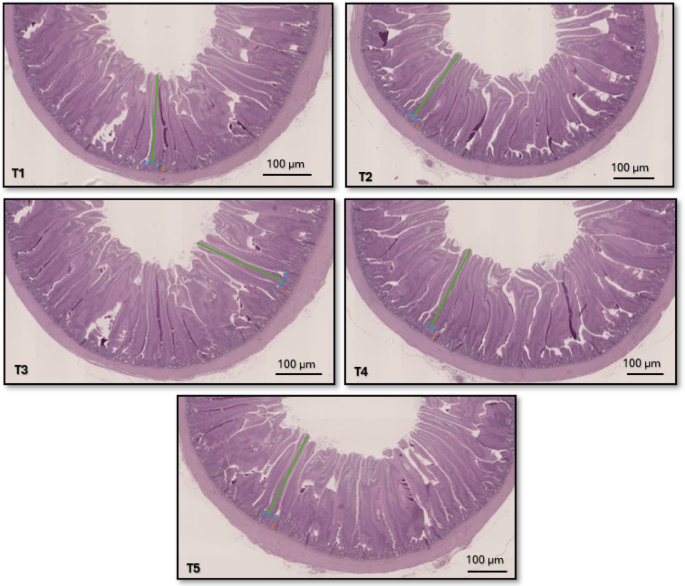
Duodenal morphology
The morphological analysis was performed following the method described by M’Sadeq et al.27. Duodenal samples were fixed in 10% neutral buffered formalin and processed using paraffin embedding techniques. Tissue samples were prepared in a Leica TP1020 tissue processor (GMI Inc., Ramsey, MN) with the following program: 30% ethanol for 2 h; 50% ethanol for 2 h; 70% ethanol for 2 h; 80% ethanol for 2 h; 95% ethanol for 1 h; absolute ethanol for 1 h (repeated twice); 50:50 ethanol: xylol for 1 h; xylol for 1 h (repeated twice); paraplast for 2 h; and paraplast under vacuum for 2 h.
Sections of 5 μm were cut using a microtome (Leitz 1516; Leica Microsystems, Bensheim, Germany) and mounted on glass slides. Slides were stained using Harris’s hematoxylin and eosin staining method. Specimens were examined using an Olympus CX41 light microscope, and images were captured with Analysis 5.0 software (Olympus Soft Imaging Solutions GmbH, Münster, Germany). Multiple measurements of villus height and crypt depth were taken per replicate and averaged to ensure representative morphological analysis.
Quantification of caecal bacterial groups
Cecal bacterial DNA extraction was performed as described by Kheravii et al.28. Briefly, 65 mg of frozen cecal samples were combined with 300 mg of glass beads, and DNA was extracted using QIAxtractor DNA Reagents and QIAxtractor DNA plasticware kits (Qiagen, Inc., Doncaster, VIC, Australia). Samples were lysed with 300 µL of Qiagen Lysis Buffer, and cells were disrupted using a bead beater mill (Retsch GmbH & Co, Haan, Germany). Subsequently, the samples were incubated at 55 °C for 2 h in a heating block and centrifuged at 20,000 × g for 5 min. DNA was extracted using an X-tractor Gene automated DNA extraction system (Corbett Life Science, Sydney, Australia). The quantity and purity of extracted DNA were assessed using a NanoDrop ND-8000 spectrophotometer (Thermo Fisher Scientific, Waltham, USA). Samples with A260/A280 ratios greater than 1.8 were deemed of high purity and stored at −20 °C for further analysis.
The extracted DNA was diluted 20-fold in nuclease-free water, and a quantitative real-time polymerase chain reaction (qPCR) was performed to quantify seven bacterial groups using a Rotorgene 6000 real-time PCR system (Corbett, Sydney, Australia). Each sample was analyzed in duplicate using an SYBRGreen-based mix (SensiMix SYBR No-Rox, Bioline, Sydney, Australia). The quantified bacterial groups included Total Bacteria, Bacillus, Bacteroides, Bifidobacterium, Lactobacillus, Ruminococcus, and Enterobacteria. Primer sequences used for bacterial quantification were as described by Nguyen et al.23. Bacterial populations were expressed as log10 (genomic DNA copy number)/g of wet digesta.
Statistical analysis
All the data derived were checked for normal distribution prior to conducting statistical analysis and then analyzed as one-way ANOVA using the General Linear Model procedure of the JMP (JMP Pro 15). Each single pen was considered as an experimental unit and the values presented in the tables are means with pooled standard error of the mean (SEM) (n = 55). When a significant effect of treatment was detected (P ≤ 0.05), the means were separated by Tukey’s test.
link