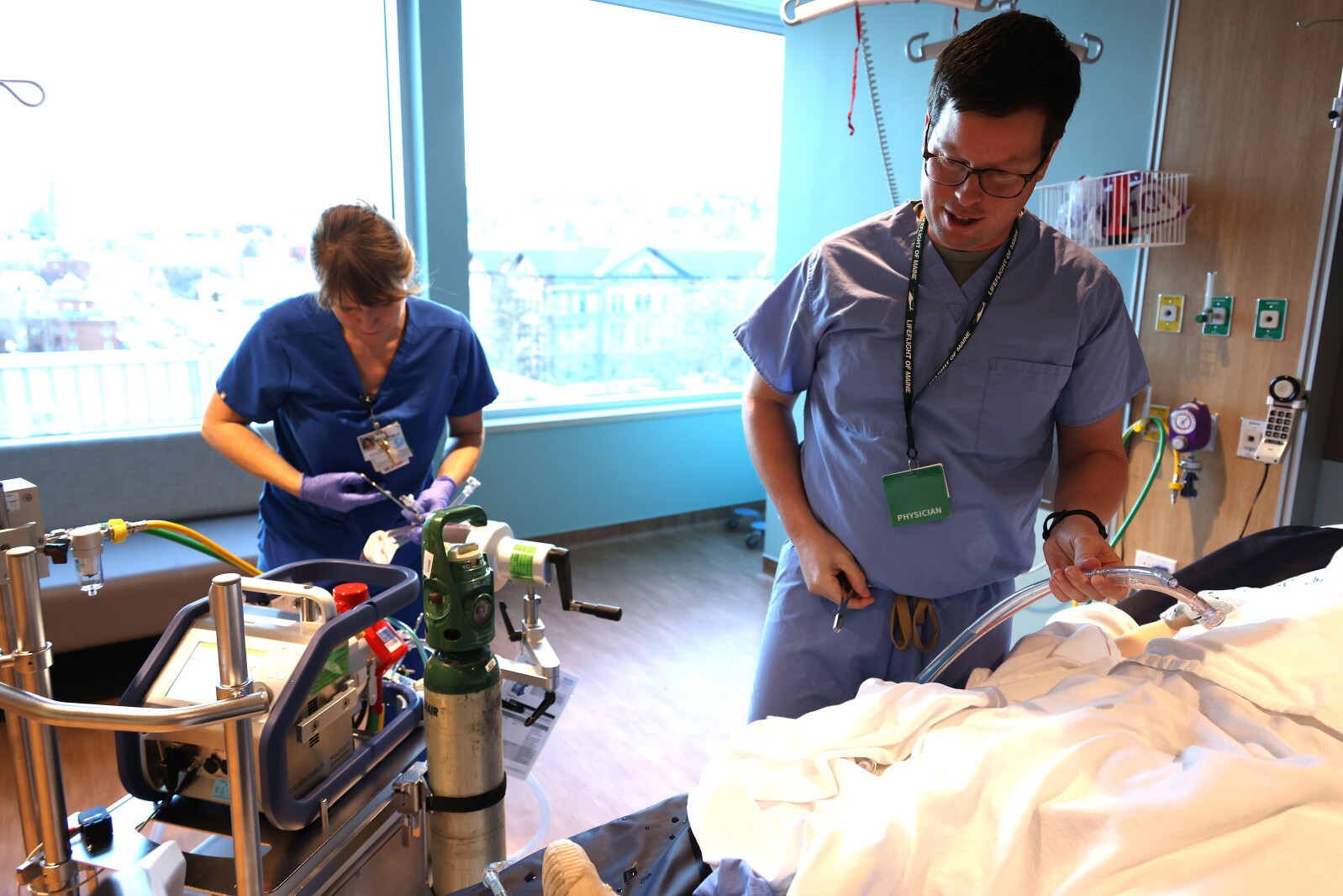
DULUTH — Aspirus St. Luke’s recently launched a fully operational extracorporeal membrane oxygenation program designed to rapidly initiate life-saving heart and lung support for critically ill patients across the region.
“During time-sensitive emergencies such as severe influenza, cardiac arrest, drowning and severe hypothermia, minutes matter,” said Dr. Matthew Spanier, who is a critical care and emergency medicine physician at Aspirus St. Luke’s.
Spanier also serves as the ECMO medical director and is credited with getting the program off the ground at Aspirus St. Luke’s.
“When I came here in 2020, ECMO was a clinical interest of mine,” Spanier said.
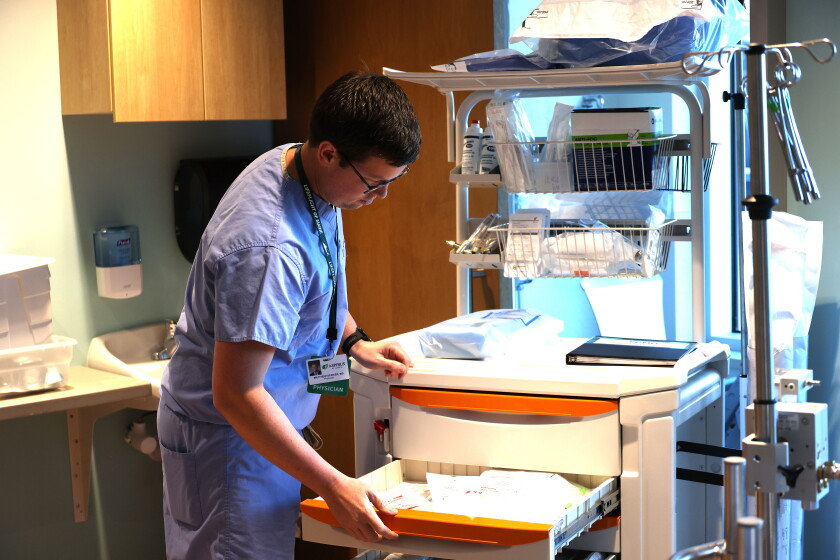
Wyatt Buckner / Duluth Media Group
ECMO supports patients with heart and/or lung failure by oxygenating and circulating blood via a pump outside the body, allowing the heart and lungs to recover.
It isn’t used until a qualifying patient is approaching about 50% mortality without it. Depending on the patient’s age or comorbidities, Spanier estimates a 90% success rate for those placed on ECMO.
“For conditions like refractory cardiac arrest, where survival is less than 10%, we know that rapidly deployed ECMO can increase that number to 30% to 50%,” Spanier explained. “You’re still really sick, right? But that’s a three-, four-, five-fold increase in survival.”

Wyatt Buckner / Duluth Media Group
In 2023, Spanier and others in the emergency department began documenting case values to pitch a proposal for the hospital to invest in the equipment and training.
At the time, there were only three staff members who were familiar with operating such a system, Spanier recalled.
“It took a few years to build, get the funds together, get the support together, get these guys trained,” Spanier said.
Aspirus St. Luke’s invested roughly $200,000 in purchasing the German-made Getinge Cardiohelp EMCO console, which Spanier said is commonly used by major centers throughout the state — making for easy transfer of patients across systems.
With the new program in place, Aspirus St. Luke’s can stabilize patients before transferring them to a partnering metro center for specialized care, where they may continue undergoing ECMO support for several more weeks.
It was most recently used to stabilize a person with influenza before then flying the patient to the Twin Cities for further care.
The system can also be used for heart failure, where it can pump blood into the arteries and generate blood pressure.
“Depending on what’s going on with the patient with heart failure, we may send them down to a transplant center, and they wait on the ECMO until they get a heart transplant,” Spanier said.

Wyatt Buckner / Duluth Media Group
Previously, critically ill patients in the region required teams from the Twin Cities or other distant centers to fly in and initiate ECMO.
Now there is a local team of ICU and Emergency Department physicians and nurses with established protocols and an internal ECMO alert process to activate support when needed.
“Having a dedicated system with two dozen trained staff members ready for ECMO response the minute a critical patient is brought through our doors is something that’s unique to our region,” Spanier said.
Aspirus St. Luke’s is the second health care system in the region to offer an ECMO system. Duluth-based Essentia Health said it began credentialing for ECMO in 2018 to support its patients with severe lung failure, as well as with heart and lung function.
Coordination with EMS and helicopter transport teams is also streamlined through the new program, enabling Aspirus St. Luke’s staff to provide a patient’s initial stabilization to reduce delays and improve outcomes.

Wyatt Buckner / Duluth Media Group
“ECMO technology is life-saving for our patients and means giving them a better chance than they had in the past of returning home to their loved ones,” Spanier said.
Clinical Supervisor Carrie Saari is the ECMO program coordinator at Aspirus St. Luke’s and has been with the organization for 20 years.
“When you see that monitor start to turn around and look better, and your patient’s color looks better,” Saari said. “This is worth it.”

Wyatt Buckner / Duluth Media Group
For nearly two decades, ICU nurse Heather Swanson has made her career at Aspirus St. Luke’s.
“There’s a reason why this hasn’t been readily available up here,” Swanson said. “There have been bumps in the road because the equipment is expensive. The training is expensive, and just to be able to staff it has been a challenge. It’s taken a lot of commitment, time and perseverance to help provide this resource.”
This fall, Swanson will lead a training program for ICU nurses to develop heightened awareness of identifying good ECMO candidates.
The ECMO program is anticipated to be utilized at least once per month on qualifying Aspirus St. Luke’s patients with lung failure or heart/lung failure who need life support beyond a ventilator.
Essentia Health said it sees similar volumes, serving about one to two patients per month with its ECMO program.
This story has been updated to correct a quote from Dr. Matthew Spanier. It was updated at 11:32 a.m. Jan. 27. This story was also updated with additional information from Essentia Health. The final version was published at 11:35 a.m. Jan. 27. The initial version was posted at 5:33 a.m. Jan. 27.
link
About the Author